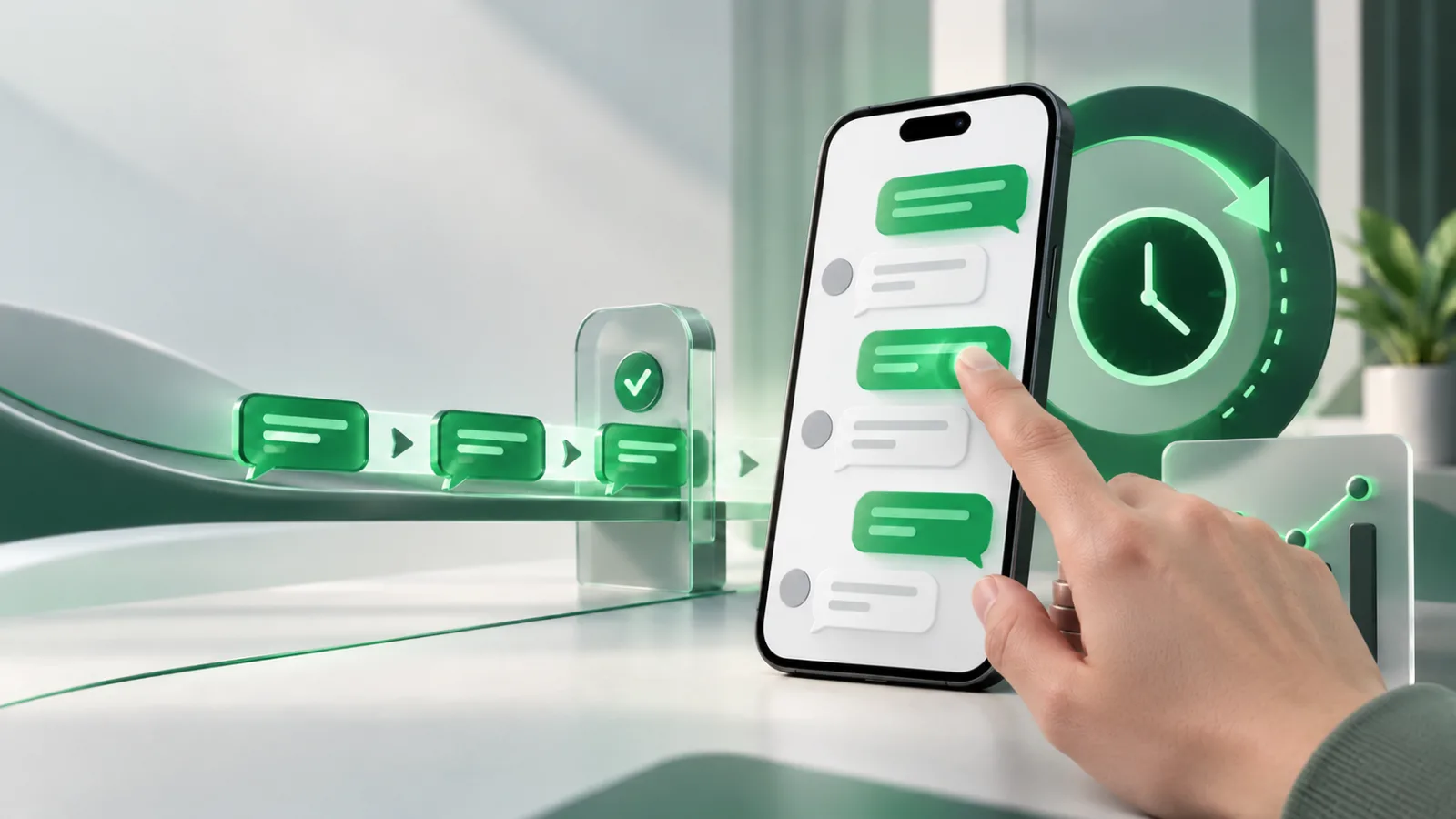
Starting October 1, 2026, Meta resumed charging for service messages delivered by businesses via the WhatsApp Business Platform. Each business phone number has a monthly allowance of 1,000 delivered service messages; after that allowance is used, billing begins at the 1,001st message. Utility templates sent within the 24-hour support window also stopped being free.
This change does not mean “WhatsApp became paid.” It affects messages sent by businesses through the WhatsApp Business Platform, also called the official WhatsApp API. Messages sent by the customer to the business are not charged by Meta, and the WhatsApp Business app should not be confused with the platform used in integrated operations.
To understand the real impact, the company needs to look beyond the number of conversations. The central billing unit is the business message actually delivered to the user. A single interaction can contain multiple billable messages sent by agents, automations, or third‑party AI solutions.
What changed in billing for the official WhatsApp API?
Until September 30, 2026, service messages and utility templates sent in response to the user within the support window could be free. From October 1, Meta resumed charging for service messages and ended the prior free status for utility templates within that window, except for specific free conditions described in the documentation.
| Situation | Until September 30, 2026 | Since October 1, 2026 |
|---|---|---|
| Service message within the 24‑hour window | Free | Monthly allowance of 1,000 delivered messages per number; billing after the allowance |
| Utility template within the 24‑hour window | Could be free | Charged, except for specific free conditions |
| Utility template outside the window | Charged | Charged |
| Marketing message | Charged | Charged |
| Authentication message | Charged | Charged |
| Message sent by the user to the business | Not charged by Meta | Not charged by Meta |
Rules are applied according to the message account’s timezone. There are exceptions and specific policies, such as those for certain eligible organizations, so the company should compare its case with the official documentation.
How does Meta charge for messages?
Billing occurs when the business message is delivered to the user, not merely when a send attempt is made. A message that was not delivered does not follow the same billing logic as a delivered message.
The applicable price depends on factors such as:
- the message category;
- the market associated with the recipient’s phone country code;
- the currency and pricing table linked to the account;
- any volume tiers in eligible categories;
- any windows or specific free policies.
Therefore, there is no single “price for the official WhatsApp API” that represents every operation. In addition to Meta’s fees, the company may contract a platform, a provider, or implementation services. Those components must be separated when estimating total cost.
Meta states it may update prices on the first day of each quarter: January 1, April 1, July 1, or October 1. Values published in articles can become outdated; the reference should be the official pricing table in effect on the analysis date.
What are the message categories?
Current technical documentation presents five categories. Each business message to the user receives a category and can generate, at most, one corresponding charge.
Marketing
Marketing messages include promotions, offers, commercial suggestions, cart‑recovery and campaigns. They are generally used to generate demand, rekindle interest, or advertise products and services.
Classification depends on the content and Meta's rules, not just the internal name given to the flow. A message labeled “relationship” by the company can be classified as marketing if its content has a promotional purpose.
Utility
Utility messages are usually related to a user action, such as order confirmation or update, payment, delivery, or scheduling. They must not contain promotional content inconsistent with the category.
From October 1, 2026, a utility template delivered within an open service window may also be chargeable. The window still defines sending permissions, but it no longer automatically makes that template free.
Authentication
Authentication messages allow sending one-time codes to verify identity in steps like access or transaction. Some markets and situations may have specific international authentication rates.
Service
A service message is a non-template message, not generated by the Meta Business Agent, sent during an open service window. It can be produced by a person, by an automation, or by a third-party AI solution.
Since October 1, these messages are part of the billing model after the monthly allowance per business number. Human or automated origin does not, by itself, change a service message into another category.
Meta Business Agent
The Meta Business Agent is Meta’s own AI solution. Non-template messages generated by it follow a separate billing mechanism related to processing and delivery.
This product should not be confused with Whatsplaid AI agents or other third-party solutions. In the case of an external agent, non-template messages sent within the window are treated as service messages according to applicable rules.
How does the 24-hour service window work?
When the user sends a message or makes a call that fits the channel rules, a 24-hour service window opens. If the user interacts again before the deadline, the timer is reset.
While a window is open, the company may send non-template messages. When the window is closed, an approved template must be used to resume contact. The window defines the allowed message type; it no longer implies unlimited free sending of everything the company sends.
This changes the operational interpretation. A team can reply freely in non-template format while the window is open, but each delivered service message counts against the allowance and, after the limit, is billed. Splitting a reply into several short messages increases the number of delivered units.
How does the 1,000 free service messages allowance work?
Each business phone number receives 1,000 delivered service messages free per month. Billing starts from the 1,001st delivered service message for that number.
The allowance:
- is tied to the business phone number;
- counts delivered service messages, not conversations;
- resets monthly according to the messaging account's time zone;
- does not roll over unused balance to the next month;
- should not be confused with a commercial plan or benefit from a contracted platform.
Thus, 1,000 messages do not equal 1,000 service interactions. If each interaction generates five company responses, 200 interactions can already represent 1,000 delivered service messages. This example illustrates the counting unit; actual behavior depends on each operation's flow.
The documentation also warns about the need to keep a valid payment method when operation continues after the allowance. The company should review this setting directly in the applicable billing environment.
How does the free entry-point window work?
There is a free window tied to eligible entry points, such as certain click-to-WhatsApp ads. According to the consulted technical documentation, after a user enters through an eligible entry point, the company must respond within the service window and meet the other conditions to open the free window.
That window can remain open for up to seven days from the company's eligible response. While open, marketing, utility, authentication and service messages may not incur delivery charges. Messages from the Meta Business Agent remain subject to their own rule.
"Up to seven days" does not mean every contact coming from any ad will automatically get a free week. Device, origin, initial response and other conditions must match what Meta documents. For that reason, the old generic 72-hour reference should not be applied without checking the current rule.
What changes for human support, automations and AI?
The resumption of service billing makes each journey's structure more visible. An isolated greeting, a separate confirmation, questions sent one by one and fragmented answers can increase the number of messages delivered without necessarily improving the experience.
This does not mean the team should withhold information or rush the customer. The goal is to remove unnecessary fragmentation. A complete response can combine context, guidance and next steps in a readable message, while a sensitive situation still requires room for dialogue.
With per-delivery charging, it is worth reviewing how automated support on WhatsApp Business organizes greetings, questions, queries and handoffs. The flow must answer what the customer asked for, avoid repetitions and recognize when to transfer to a person.
For third-party AI solutions, the relevant volume is not just the number of customers served. You need to measure how many service messages the agent sends per case, how it reacts to ambiguous requests, whether it repeats information and when it stops the automation.
How to estimate the impact on operations?
Rather than starting from an isolated tariff, map the number of messages per journey. A simple method is:
- separate the relevant journeys, such as support, qualification, ordering and after-sales;
- count company messages delivered in a representative sample;
- classify each message as marketing, utility, authentication, service or Meta Business Agent;
- identify messages covered by the allowance or by an eligible free window;
- apply current market rates and the corresponding currency;
- add subscription, implementation and other separately contracted costs;
- repeat the calculation for normal and peak volume scenarios.
A simplified operational formula for service is: service messages delivered in the month, minus valid messages in the allowance and other free conditions, multiplied by the applicable official rate. The final calculation must consider account rules and should not mix messages from different categories.
Also track the mean and distribution. An average of four messages per support case can hide flows with two messages and problematic cases with twenty. These extremes help find repetition, integration failure or lack of human handoff.
How to make conversations more objective without harming the customer?
Efficiency does not simply mean sending fewer messages. It means reducing messages that add no information, without removing context, clarity or access to a person.
- combine greetings and initial guidance when this remains readable;
- avoid splitting the same idea into several consecutive messages;
- do not repeat a question already answered by the customer;
- consult sources and integrations before stating status or availability;
- send summary and next steps together when it makes sense;
- pause the automation when the Inbox for teams on WhatsApp Business receive the conversation;
- leave space for clarifications in complex cases.
A short conversation is not necessarily efficient, and a long conversation is not necessarily wasteful. The criterion should combine resolution, accuracy, safety, and the number of messages needed for the case.
How does Whatsplaid relate to this scenario?
Whatsplaid is a platform for WhatsApp Business that organizes AI agents, knowledge, automation, and human involvement within a business operation. The company can monitor conversations, configure the agent, and hand off interactions to the team according to the adopted flow.
In customer service via WhatsApp Business, the review should consider both response quality and the number of messages generated by greetings, questions, queries, and failures. Whatsplaid does not use the Meta Business Agent and does not convert Meta’s rates into its own product allowance.
The Whatsplaid plans present the platform subscription. Meta fees, channel rules and any additional charges must be checked separately according to the account, market, category and configuration adopted. There is no automatic saving: the result depends on the actual volume and behavior of conversations.
Frequently asked questions
Has the WhatsApp Business app started charging per message?
This article deals with the WhatsApp Business Platform, used in operations connected to the official API. The same rule should not be automatically applied to isolated use of the WhatsApp Business app.
Are replies within the 24‑hour window still free?
Not unlimitedly. Non‑template messages can be sent while the window is open, but service messages delivered count against the monthly allowance and are billed after it. Utility templates within the window may also be charged.
Does the company pay for messages sent by the customer?
No. Meta states that user messages to the company are not charged. The charge analyzed here applies to company messages delivered to the user.
Is the 1,000‑message allowance per account or per number?
It is assigned to each business phone number. Unused balance is not carried over and the allowance resets monthly.
Does a conversation with ten replies consume one or ten messages?
The unit is the delivered message. If the company sends ten service messages that are delivered, there will be ten service units in the count, even if all are part of the same conversation.
How to know the applicable rate for Brazil?
Check Meta’s official table on the calculation day, select market, currency and category and record the date. Do not confuse Meta’s rate with a subscription or fee from a contracted platform.
Are Brazilian accounts always billed in reais?
You should not assume that for all accounts. Meta states rules for qualification and migration to local billing; the company needs to verify the currency, the billing entity and the schedule applicable to its own registration.
Sources consulted
The rules in this article were verified on October 9, 2026. Technical documentation should prevail when there is a discrepancy with commercial pages or third‑party articles.
- Official pricing documentation for the WhatsApp Business Platform.
- Official WhatsApp Business pricing page.
- Meta terms for WhatsApp Business.
Because prices and mechanisms can be updated, confirm the table, categories, windows and account conditions before making a financial or operational decision.